In This Article
Overview
Three-dimensional printing has evolved from a prototyping curiosity into a legitimate construction technology capable of producing structural components, custom facades, and bespoke architectural elements with millimeter-level precision. At Versailles Luxury Homes, we partner with leading 3D printing fabricators to create custom luxury components — intricate cornice profiles, curved staircase elements, sculptural fireplace surrounds — that would require months of traditional craftsmanship or be simply impossible to execute with conventional tools.
The democratization of complex form through 3D printing is fundamentally expanding what "custom" means in luxury residential architecture. Forms that previously required specialized stone carvers, master mold makers, or years of accumulated craftsman skill can now be designed digitally and fabricated at any scale with absolute geometric precision. For DFW luxury homeowners who demand truly unique residences, 3D printing opens a new chapter in architectural possibility.
From Prototyping to Production
The 3D printing process begins with precise digital modeling, either from our architects' designs or from 3D scans of reference elements. Files are prepared for the specific printing technology being used — FDM, SLA, SLS, or concrete extrusion — optimizing orientation, support structures, and layer parameters for the best surface quality and mechanical performance. Most luxury architectural components are printed in sections that are assembled on site, allowing fabrication of elements larger than any print volume.
Custom Decorative and Architectural Elements
- Intricate cornice and molding profiles — any geometric complexity, any scale
- Custom column capitals and bases in classical or contemporary styles
- Sculptural fireplace surrounds with organic forms impossible in traditional stone
- Parametric facade panels creating unique exterior character
- Custom hardware and fixture components matching bespoke design intent
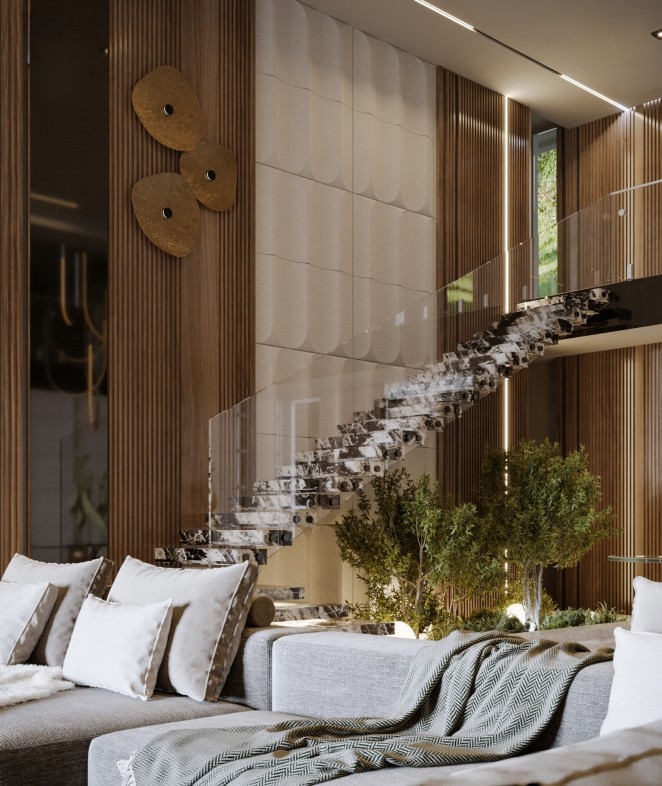
- Staircase baluster and railing systems with complex geometries
Large-Format Concrete 3D Printing
Large-format concrete 3D printing — used by companies including ICON, COBOD, and CyBe — has advanced rapidly, with systems now capable of printing structural wall elements at speeds of several hundred square feet per day. While full-home concrete printing is still emerging, the technology is immediately applicable to site-cast decorative elements: printed pool surrounds, landscape walls, custom outdoor fireplaces, and bespoke exterior cladding panels that would be cost-prohibitive through conventional formwork.
Digital Design to Physical Reality
The workflow from digital design to fabricated component is now seamless. Our architectural team designs elements in parametric modeling software — Grasshopper, Rhino, or Revit — that generates both the fabrication geometry and the shop drawings simultaneously. This eliminates translation errors between design intent and fabrication reality, ensuring that the installed component matches the design model exactly.
3D Printing Materials for Luxury Applications
- High-density polyurethane foam — lightweight architectural moldings with gypsum-hard coating
- Resin composites — high-detail decorative elements with stone-like finish
- Carbon fiber reinforced polymers — structural components with maximum strength-to-weight ratio
- Engineered concrete blends — weather-resistant exterior elements with structural capability
- Metal sintering — custom hardware, fixtures, and structural connectors
Cost, Schedule, and Quality Trade-offs
Three-dimensional printing is not universally cost-competitive with traditional fabrication for simple elements, but its economics are compelling for complex, one-of-a-kind, or highly detailed components. For a custom fireplace surround that would require a master stone carver 200 hours to complete, 3D printing may produce an equivalent result in 20 hours at 40% of the cost. The trade-off is material choice — printed elements have different aesthetic and tactile properties than hand-carved stone — but for many applications, printed components match or exceed the quality of traditional methods.
Three-dimensional printing does not replace craftsmanship — it amplifies it, allowing our designers to realize forms that master craftsmen could never have executed at any price.
Key Takeaways
- 3D printing enables custom architectural elements of any geometric complexity at competitive cost.
- Large-format concrete printing is immediately applicable to exterior architectural elements.
- Digital design to fabrication workflows eliminate translation errors between intent and reality.
- Printed components in foam, resin, composite, and concrete suit different luxury applications.
- 3D printing is most cost-effective for complex, one-of-a-kind decorative and structural elements.